
Thursday, March 12, 2026 | Today's Newsletter | Login
Canada’s oceans provide billions in value beyond fish
By Rochelle Baker,
Local Journalism Initiative Reporter
Canada’s healthy oceans are worth billions more than what can simply be extracted from them. Oceans and coastal ecosystems generated at minimum $7.1 billion in benefits in 2023, new figures from Statistics Canada suggest.
The study is part of the federal government's efforts to value more of the advantages nature can offer to people and communities.
By estimating the monetary value of marine “ecosystem services”, the federal government is taking a new approach to quantifying the often ignored perks that oceans provide — such as clean water, wildlife or climate benefits — in addition to measuring the revenue from traditional resource industries like fishing, explained McGill University professor Brian Robinson, an expert in ecosystem services.
“It makes these things visible — which are typically invisible in most policy contexts — when making decisions around development opportunities,” he said.
Given its vast coastlines, Canada is working to put a price on the ocean’s ability to sink planet-heating CO2 to meet climate goals, curb the climate impacts and trade carbon credits based on emissions reductions in the global market.
Statistics Canada’s analysis estimated the value of some ways oceans store carbon at $5.5 billion in 2023 alone.
Marine carbon storage, also called “blue carbon,” is valued for how much planet-heating CO2 is drawn from the atmosphere and safely tucked away by microscopic ocean phytoplankton, coastal salt marshes, eel grass meadows or kelp forests. The monetary value of blue carbon is based on existing federal carbon prices.
Other ocean benefits tallied up by Statistics Canada included $1.2 billion in commercially harvested fish and seafood in 2023.
Coastal tourism alone in Canada is estimated to be worth $458 million.
The estimates don’t reflect the full value of the two industries or blue carbon but act as a partial snapshot.
However, the figures are a good first step in valuing some of the ocean’s many ecosystem services, Robinson said.
“They are preliminary, subject to revision and always subject to better data and better methods for estimates.”
Working out a standardized monetary value for things such as blue carbon or the flood prevention from salt marshes can make nature’s contributions comparable with standard economic data from traditional resource industries, like commercial fishing, where the economic value is already well-understood, he said.
Ecosystem services accounting doesn’t make arguments for conservation or resource development, Robinson noted. Instead, it’s a tool that clarifies the trade-offs involved in decisions that can impact nature.
Ecosystem accounting also doesn’t measure if an ocean-derived benefit like fishing is sustainable, Robinson stressed. The system can track changes in economic value over time, but doesn’t measure key factors such as the health of fish stocks or marine ecosystems — or anticipate future losses.
“There’s no estimation here of are we doing the are we doing the right things,” he said. “Can we continue extracting this sort of value from fisheries into the future? It doesn't say anything about that.”
Tourism operators on the West Coast clearly understand that healthy oceans underpin the region’s economy, said Cassandra Zerebeski, executive director of the Wilderness Tourism Association of B.C.
Coastal tourism plays an increasing role in the sector, which is the economic backbone of the provincial economy, she said.
The Vancouver Island region's tourism revenue alone amounted to $3.2 billion in 2022. And tourism across all of BC contributed $9.7 billion to the province’s gross domestic product (GDP) in 2023, outstripping all other primary resource industries and nearly double the GDP contributions made by mining or the oil and gas sectors.
Healthy oceans and shorelines support rich wildlife and thriving coastal communities — both of which are synonymous with Canada’s brand.
They “aren’t just a nice to have” but central to tourism’s ongoing economic success, said Zerebeski.
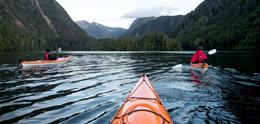
The places and activities that attract visitors to the coast and Vancouver Island such as whale watching, small-ship tours, kayaking, scuba diving, surfing or stay at remote lodges, all rely on an unspoiled marine environment, she said.
The tourism sector itself is working on reducing its own impacts on the coast’s environment and travel destinations, said Zerebeski, speaking to Canada’s National Observer while attending a sustainable tourism conference in Victoria.
“The environment isn’t just scenery for us. It’s the product and core to how we position ourselves, and the values we [reflect] to the province and the guests we’re trying to attract.”
Coastal tourism operators — typically small business owners — often invest their own time and money into conservation initiatives that also protect tourism value, Zerebeski said.
They take part in marine debris clean-ups or contribute to ocean science projects by attaching sensors to their vessels to measure ocean acidification or oxygen levels in water. Knowledge accrued from those activities is often incorporated into educational opportunities for visitors.
Paula Amos, chief marketing and development director at Indigenous Tourism BC, agreed that living oceans are foundational to economic benefits.
Safeguarding culture and nature are intertwined with Indigenous tourism, she said.
“When First Nations communities are looking at economic development, they’re always going to look at it holistically,” Amos said. “How is it impacting our people, the land, our food resources? Indigenous tourism is always done with that lens in mind.”
The benefits of doing so are plain.
Indigenous tourism in the province has grown by 40 per cent over the past four years and generated $1.1 billion in total economic impact in 2023, she said.
Cultural eco-tourism is filling the gaps left behind by shrinking forestry and fishing resource sectors over the past decade, she said.
“More and more of the First Nations communities on the coast are looking at tourism as an economic driver,” Amos said.
Robinson cautioned ecosystem accounting can’t capture the full worth of everything oceans provide to individuals or communities.
The tourism sector can measure what a visitor paid for a whale watching trip or hotel room but can’t capture the thrill or enjoyment at seeing a humpback or grizzly bear.
Non-material benefits like cultural relationships, food security, community well-being and the intrinsic value of wildlife can’t fully be measured.
“The joy of being on the ocean or just coming together as a family and having a bonfire on the beach — we don’t have ways of putting prices on those things.”
Rochelle Baker / Local Journalism Initiative / Canada's National Observer.
Leave a comment