
Sunday, May 10, 2026 | Today's Newsletter | Login
Historic Sikh tomb on brink of ruin
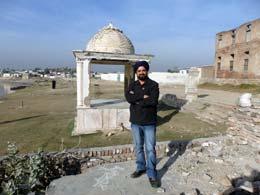
Bobby Singh Bansal,
Special to The Post
Near the border of Pakistan and Afghanistan, in a rugged frontier province lies the tomb of famed Sikh warrior, Akali Phoola Singh.
I was recently in Pakistan and visited the tomb, which is surrounded by several forts originally built by General Hari Singh Nalwa in the 1830s.
These forts are now in the control of the Frontier Constabulary and still proudly stand in their original form. However the tomb of Akali Phoola Singh is in desperate need of repair.
During the floods of 2010 several historical Sikh monuments located near the Kabul river were damaged beyond recognition. One of these monuments was the tomb of Akali Phoola Singh.
The tomb was constructed at the spot where the gallant Akali fell on March 21, 1823 during the Battle of Naushera. According to historians, the Akali commander fought the Pashtun forces under Muhammad Azim Khan Barakzai, and led 500 of his Akalis to Pir Sabaq, a small village lying north east of Naushera.
His troops were part of a large contingent of 8000 Sikh troops led by Prince Sher Singh who entrenched himself to the east of Pir Sabaq.
The small hill of Pir Sabaq was the highest vantage point of the village. General Ventura’s Gurkhas and Muslim regiments advanced towards the hill, supported by Akali Phoola Singh riding a war elephant.
Here they were met by a fierce storm of musketry, and for about an hour the rival armies were locked in deadly hand-to-hand combat.
Phoola Singh’s elephant rider was wounded and in the panic he tried to retreat. The desperate Akali commander pulled out his pistol from his belt and shot him through his head, before urging the animal on himself with his sword until he himself was struck down. He was cremated on the spot where he fell by Maharajah Ranjeet Singh and a marble tomb or samadhi was erected in his honour.
On this journey to the Akali tomb, I was accompanied by a cultural activist Dr. Ali Jaan and a local colleague Awais Khattak, a great grandson of the famous poet Khushal Khattak to Naushera.
Currently, the only access to Pir Sabaq is by a makeshift cable car that ferries passengers about 50 feet above the river. Once across, the sacred tomb is visible, standing desolately on the banks of the river.
Locals had stated that the tomb was partly submerged during the vicious floods back in 2010, and that the lower portion of the tomb has been damaged.
The tomb was built in pink marble and stands about 10 feet in height and 5 feet in width. Adjacent to the tomb was the Akali Barracks, which no longer exists, and an abandoned Sikh temple that is being used as a warehouse.
Most of the outer walls that surrounded the tomb have been damaged beyond recognition as well as the marble pillars that were part of the tomb’s entrance.
This is a monument of historical importance dating to the reign of Maharajah Ranjeet Singh. It is imperative that we now work towards restoring the tomb as well as preserving it for posterity. This is not only the heritage of the Sikhs in Pakistan, but the shared heritage and culture of Sikhs and historians globally.
Bobby Singh Bansal is a British born Sikh writer and filmmaker. He can be contacted via email - [email protected].
Leave a comment